There are certain vegetables and herbs that grow well together and some that do not. If we are to grow vegetables in our smaller urban areas we need to know how to plant our "streets and alleys" in the different areas of our gardens. It will be like planting our own neighborhoods in away. You can choose your own vegetables based on location of the solar light bulb and how long your plants get the power that it needs as well as personal tastes (of course).
The Iroquois Indians or the Haudenosaunee the Eastern side of North America did this. First they would plow the field near their longhouse. Then the would "plant" fish heads (fertilizer-bone meal) and then they would plant corn first cover it with dirt and wait a few weeks until the corn was growing. Then the squash and bean seeds were added into the fish head. Then they would wait for the results.
So I am learning how to do this today in my backyard garden. I have planted in beets this year in my pots-but they are getting crowded so I have moved them out to share the space in between my brussel sprouts. But apparently beets do well with several other plants like-lettuce,carrots, cucumbers and radishes.
I have found out that buttercups and clover or alfalfa do not like each other. They are not good neighbours. Clover adds nitrogen to the soil(good) and buttercups secrete a substance that inhibits the growth of nitrogen. Clover will disappear in a field of buttercups. Buttercups also mess up the digestive system of adults and children.
Did you know that certain plants speed up the break down of compost?- like stinging nettles and comfrey,
dandelions (iron), salad burnet (magnesium) , sheep sorrel, chicory, goose grass and horsetails, bush vetch, thistles and ribwort.
The Iroquois Indians or the Haudenosaunee the Eastern side of North America did this. First they would plow the field near their longhouse. Then the would "plant" fish heads (fertilizer-bone meal) and then they would plant corn first cover it with dirt and wait a few weeks until the corn was growing. Then the squash and bean seeds were added into the fish head. Then they would wait for the results.
So I am learning how to do this today in my backyard garden. I have planted in beets this year in my pots-but they are getting crowded so I have moved them out to share the space in between my brussel sprouts. But apparently beets do well with several other plants like-lettuce,carrots, cucumbers and radishes.
 |
| stinging nettle |
 |
| salad burnet |
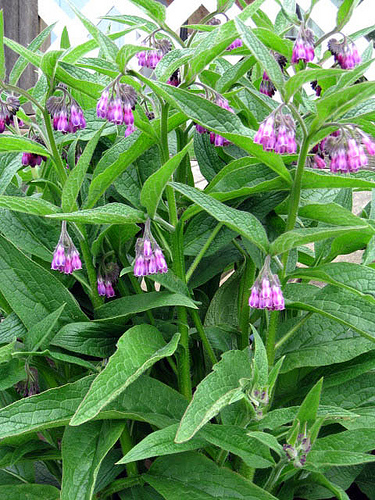 |
| comfrey |
I have had comfrey growing in my garden and I did not know it!! Unless you know the "stranger " in your garden allow him shelter.
My mother would throw out everything she did not plant. I was doing the same thing until this year. The above is my new motto for my garden...ever since I have learned about the dandelion and the mint.
There is so much I do not know about plants.
I have found this last bit of information in a book Carrots love Tomatoes
by Loise Riotte. I am finding a lot of fascinating information in this book about the relationship of plants. Including how a lightening bolt will help your garden. Apparently, each time lightening strikes the earth, large amounts of nitrogen are charged into the ground. Rain will also bring nitrogen, selenium and molybdenum. Rain also brings sulfur, carbonic acid forming carbon dioxide in the soil. Dust, fog and snow are also useful agents in the distribution of nutrients. You can help with passage of electrical currents. "Electro-culture" is obtained by using metal trellises and tying plants especially tomatoes to the trellis with a common nylon strips from discarded panty hose.
I am not sure about your garden this year, but my tomatoes could use this help. Maybe planting under the hydro wires is not such a bad thing.


No comments:
Post a Comment